
Loading...
Skip to main content

Every generation is given truth. This one is forced to confront it.

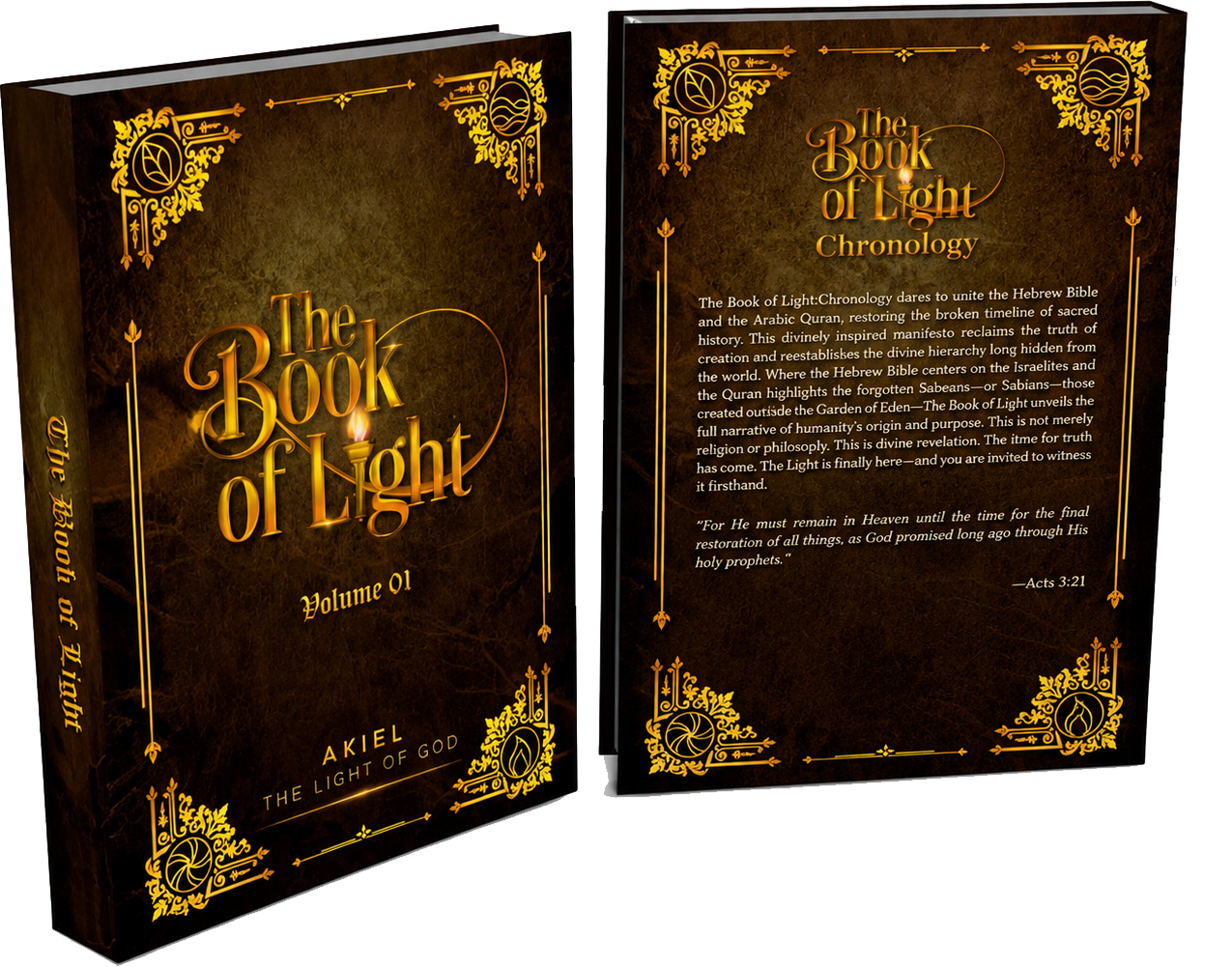
The Book of Light is a modern-day exposition of ancient Scripture—restoring a unified narrative between the Hebrew Bible, the Quran, and the lost records of antiquity.

What Is The Book of Light?

The Book of Light is a comprehensive reexamination of sacred history—drawing from the Hebrew Bible, the Quran, apocryphal texts, and ancient mythologies—to reconstruct a unified narrative long obscured by time, translation, and tradition.

At its core lies a single assertion: the story of humanity, creation, and divine governance has been misunderstood.

“Creation didn’t happen once. It happened twice.”

This work challenges inherited interpretations and presents a structured chronology that distinguishes between two origins of mankind, redefines the role of divine intermediaries, and reveals a broader cosmic framework behind Scripture.

Key Revelations

Volume I: Chronology

The first installment in The Book of Light trilogy establishes the foundation—reconstructing the timeline of creation, defining the distinction between human origins, and introducing the structure of divine governance through a parallel examination of ancient texts.

Chronology clarifies that:

  • Creation occurred in two distinct phases, not one
  • Humanity consists of two origins: the Sabeans and the Hebrews
  • The Hebrew Bible and the Arabic Quran are not separate accounts—but one unified narrative
  • The so-called “fallen angels” represent a misunderstood class of entities operating within creation
  • The divine order includes a council of ruling Majesties governing a multi-realm system

The Book of Light is not a new story—it is a restored one.

It is not written merely to inform, but to correct—to restore clarity where confusion has persisted, to unify what has been divided, and to present ancient texts as a single, continuous narrative.

About the Author

Born Curly Raphino, Akiel is an independent author and researcher based in Atlanta, Georgia.

Following a life-changing divine encounter, he undertook an extensive comparative study of Biblical, Quranic, and apocryphal texts over the course of several years.

His work synthesizes these sources into a single cohesive framework—challenging long-standing interpretations and presenting an alternative understanding of sacred history.

The Book of Light represents the culmination of that study.

The Hebrew Bible and the Arabic Quran are one

By UncategorizedNo Comments

According to The Book of Light, the Hebrew Bible and the Arabic Quran should not be viewed as unrelated or competing sacred texts but as complementary witnesses preserving different accounts of the same ancient history. Although separated by language, culture, and centuries of transmission, the two Scriptures repeatedly intersect through shared patriarchs, prophets, historical events, divine judgments, and accounts of the Most High’s interaction with humanity—sometimes telling the same story, sometimes supplying details absent from the other, and sometimes approaching sacred history from different religious perspectives.

The correspondence becomes particularly evident in the individuals and events both Scriptures preserve. Adam and Eve, Noah, Abraham, Ishmael, Isaac, Jacob, Joseph, Moses, Aaron, David, Solomon, Elijah, Jonah, John the Baptist, Mary, and Jesus all appear within both traditions—as do creation, the Garden, the rebellion of Satan, the Flood, the Exodus, the giving of divine law, the ministry of the prophets, the Messiah, resurrection, and judgment. According to The Book of Light, this extensive overlap reveals that the two Scriptures participate in the same larger sacred narrative rather than recounting two entirely separate religious histories.

Within this framework, however, correspondence does not mean repetition. The Hebrew Bible primarily chronicles the history of the Hebrews—particularly the covenantal lineage descending through Abraham, Isaac, and Jacob—while the Arabic Quran frequently preserves the history of the Sabeans, a people whose nations and historical events receive comparatively little attention within the Hebrew record. The Book of Light therefore examines the Hebrew Bible as principally preserving the Hebrew side of sacred history and the Arabic Quran as preserving significant portions of its Sabeanic counterpart… Read More
Read More

The Sabeans

By UncategorizedNo Comments

According to The Book of Light, the Sabeans—known as Sabians in the Quran—represent one of the most overlooked and enigmatic populations in sacred history. While the Hebrew Bible principally follows the lineage descending from Adam and Eve, The Book of Light proposes that a pre-Adamic human population already existed outside the Garden of Eden: the Sabeans, a distinct order of humanity created during the first stage of creation on the sixth day in Genesis Chapter 1.

Remarkably, the Sabeans appear by that designation only three times in the Hebrew Bible (Job 1:15; Isaiah 45:14; Joel 3:8). The Arabic Quran likewise names the Sabians only three times (The Quran 2:62; 5:69; 22:17). Yet neither sacred record provides an extended explanation of who these mysterious people were. They simply appear within the respective narratives without any explanation of their origin or identity, leaving the question of who they were to later generations.

Within biblical scholarship, the Sabeans have commonly been associated with the Sabaeans—the inhabitants of Saba, or Sheba, the ancient kingdom famously associated with the Queen of Sheba. The Book of Light, however, questions whether these populations should automatically be regarded as identical. Sheba already appears throughout the Hebrew Scriptures as an identifiable name, people, and geographical tradition, whereas the comparatively obscure Sabeans appear independently within passages such as Job 1:15, Isaiah 45:14, and Joel 3:8. Rather than assuming that the similarity of these names establishes their identity, The Book of Light examines the possibility that the Sabeans represent an altogether different and considerably older population… Read More

Read More

Adam and Eve

By UncategorizedNo Comments

According to The Book of Light, Adam and Eve were not the first human beings to inhabit the Earth. They were the first members of a second and distinct order of humanity, created after the establishment of the Sabean population in Genesis Chapter 1. Whereas the Sabeans (man or mankind) were created collectively on the sixth day and distributed throughout the world, Adam (the man) appears separately in Genesis Chapter 2 as a single man, formed from the dust and then placed within a specially prepared Garden.

“Then the Lord God formed the man of dust from the ground and breathed into his nostrils the breath of life, and the man became a living creature. And the Lord God planted a garden in Eden, in the east, and there He put the man whom He had formed.” (Genesis 2:7-8)

This particular creation is also described as the act of a singular Deity—a distinction that forms one of the foundational principles of The Book of Light’s reconstructed chronology. Where Genesis Chapter 1 employs the plural “Us” and “Our,” the creation of Adam is framed in the singular, a contrast the book regards as theologically significant. The Quran affirms the same point, preserving the creation of Adam as a direct act of the Lord God alone… Read More

Read More

The Hebrews

By UncategorizedNo Comments

The Hebrew story begins where the story of Adam and Eve leaves off. According to The Book of Light, Adam and Eve were the progenitors of a distinct genealogical family whose descendants became known as the Hebrews (Exodus 2:11; Jonah 1:9; Philippians 3:5). Unlike the Sabeans, who began as a global population distributed throughout the Earth, the Hebrews originated from a single ancestral pair and expanded one generation at a time through a carefully preserved bloodline (Genesis 5:1-32; Luke 3:23-38).

The Book of Light associates the term Hebrew with the concept of “crossing over” or “coming from beyond.” Within the book’s reconstructed chronology, this designation traces back to Adam and Eve themselves. After their expulsion from the Paradise of Eden, they crossed over from the protected realm they had inhabited into the broader world beyond the Garden (Genesis 3:23-24), becoming strangers and sojourners among populations that preceded them. The identity of the Hebrews as sojourners would become a recurring theme throughout the history of their descendants (Genesis 23:4; 1 Chronicles 29:15; Hebrews 11:13).

For generations, however, the Hebrews remained a family rather than a nation. Their genealogy continued through Adam, Seth, and Noah, whose sons, Japheth, Ham, and Shem, established diverging branches of the Hebrew family. Through Shem, the covenantal lineage outlined in the biblical narrative continued through Abraham, Isaac, and eventually the twin brothers Jacob and Esau. It was with Jacob that a major partition occurred within the Hebrew family. The Lord renamed Jacob Israel, and his twelve sons became the progenitors of the twelve tribes of Israel (Genesis 32:28; Genesis 35:10-12). From that point forward, one branch of the larger Hebrew family possessed a new covenantal and national identity: Israel… Read More

Read More

Creation Happened Twice

By UncategorizedNo Comments

According to The Book of Light, one of the greatest keys to understanding the opening chapters of Genesis is recognizing that creation happened twice. Genesis Chapters 1 and 2 are traditionally read as two descriptions of the same creation event. The Book of Light, however, argues that the differences between them are too numerous and consequential to dismiss as simple repetition. Within the book’s reconstructed chronology, the two chapters describe two distinct stages of creation, separated by an interval of time and involving different creative circumstances, environments, vegetation, animal kingdoms, and orders of humanity.

The first creation unfolds on a planetary scale throughout the familiar six days of Genesis Chapter 1. The Earth brings forth vegetation, plants, and fruit-bearing trees on the third day (Genesis 1:11-13). Creatures of the sea and birds of the heavens appear on the fifth day (Genesis 1:20-23). Land animals are created on the sixth day, followed by mankind (Genesis 1:24-27). Only after the planetary environment and its living creatures have been established does the Most High GOD, together with HIS Helpers, declare:

“Let Us make man in Our image, according to Our likeness.” (Genesis 1:26)

Mankind is then created collectively as male and female, blessed, commanded to multiply and replenish the Earth, and given dominion over its living creatures (Genesis 1:26-28). Within The Book of Light’s framework, these were the Sabeans—the first order of humanity and the progenitors of the world’s non-Hebrew populations… Read More

Read More

The Quran

By UncategorizedNo Comments

Is the Quran Scripture?

For millions of Muslims throughout the world, the answer is unquestionable. For many Jews and Christians, however, the Quran occupies an entirely different category—an Islamic religious text originating centuries after the Hebrew Bible and New Testament and therefore existing outside the scriptural tradition they recognize. The Book of Light approaches the question differently. Rather than beginning with religious affiliation, the book asks a more fundamental question: What is the Quran, where did it come from, and what does it claim to be?

Even its name provides an important clue.

The Arabic word Qurʾān (القرآن) carries the meaning of recitation or that which is recited. This distinction is significant because the Quran did not originate as a completed book written by Muhammad and presented to his followers. According to Islamic tradition, it originated as a spoken revelation delivered progressively to Muhammad and recited by him to others. The Quran was therefore a Recitation before it was a book… Read More

Read More

THE BOOK OF
LIGHT

Contact Information

This Website Belongs To The Book Of Light